One spill, one muddy paw, or one sharp claw can turn a beautiful sofa into a daily worry. If you have kids, pets, or a busy space, you need protection that still looks chic, not a loose cover that slides and bunches.
That is where a perfect fit matters. In this made-to-measure sofa cover measuring guide, you will learn how to measure a sofa for a custom cover with confidence, even if your piece is vintage, premium, or an awkward shape.
We will walk through simple steps to get a custom slipcover fit that stays put, looks tailored, and supports options like a stain-resistant sofa cover or a pet-friendly couch cover.
Let’s start with the tools you need and the key measurements to take first.
Before You Measure: 3 Minutes of Prep That Prevents a Bad Fit
A beautiful, tailored result starts before the tape measure comes out. In this made-to-measure sofa cover measuring guide, these quick prep steps help you avoid the most common causes of a poor custom slipcover fit such as measuring over bulky throws, skipping arm height, or not confirming whether cushions are attached or removable. Take three minutes now, and you will save yourself days of living with a cover that slides, bunches, or looks “almost right.”
Your 3 minute prep checklist (do this first)
1) Gather the right tools (so your numbers are consistent)
- Flexible measuring tape (soft tape, not a rigid ruler)
- Notepad or phone notes (create a simple list: Width, Depth, Back Height, Arm Height, etc.)
- Masking tape (to mark start and end points on long sofas or sectionals)
- A helper (especially for 3 seat sofas, sectionals, and any deep or extra-wide piece)
Why this matters: when you measure alone, the tape often bows or shifts, which can add extra inches and lead to a cover that looks loose. A helper keeps the tape straight and the fit more precise.
2) Strip off “extra layers” that change the shape
Remove:
- Throws and blankets
- Bulky decorative pillows
- Any temporary padding (like toddler bumpers or pet beds)
Keep in place (for now):
- The sofa itself and its usual cushions, unless they are unusually puffy add-ons
Actionable rule: Measure the sofa’s true shape, not what is sitting on top of it. One of the biggest fit issues happens when people measure over a draped throw, then wonder why their cover looks too large and shifts.
3) Decide what you want covered (so you measure the right parts)
Before you measure, choose your coverage goal:
- Frame only: ideal if you want a sleek look and you already like your cushions
- Frame + seat cushions + back cushions + armrests: best for busy homes that need everyday defense from spills, crumbs, and claws
This decision directly affects which measurements you record. For example, if you want a stain-resistant sofa cover that truly protects snack time and movie nights, you will likely want cushion coverage too, not only the frame.
If you want to browse coverage styles while you plan, start here: Sofa and Couch Covers.
4) Do a quick “shape ID” so you do not measure the wrong way
Take 10 seconds to label your sofa type:
- Standard sofa (2 to 3 seats)
- Loveseat
- Sectional or L-shaped
- Recliner sofa
- Sofa with attached cushions (seat and or back cushions fixed to the frame)
Why this matters: the answer changes how you approach the next steps in how to measure a sofa for a custom cover. For instance, sectionals should be treated like modules, and recliners need measurements taken with the footrest closed.
5) Family and pet tip: mark your high-risk zones
If your home includes kids, pets, or both, your “mess map” is not random. Quickly note the spots that take the most wear:
- Seat front edge (shoe scuffs, snack drips, constant sliding in and out)
- Arm tops and arm fronts (favorite perch for dogs, scratch zone for cats)
- Corner seat (where everyone piles in)
This helps you prioritize protection where it matters most, especially if you are choosing a pet-friendly couch cover or planning extra coverage for the most used cushion. It also helps you double-check those measurements later, since these areas are where a sloppy fit shows first.
With your sofa cleared, your coverage goal chosen, and your shape confirmed, you are ready for the measurements that most custom orders rely on. Next, we will walk through the core numbers to record so your cover looks clean, chic, and stays put through real life.

The Core Measurements (Most Custom Orders Rely on These)
If you only take a few numbers, make them these. They are the foundation of a true custom slipcover fit that stays smooth when kids bounce, pets nap, and life happens. In this part of our made-to-measure sofa cover measuring guide, you will learn exactly how to measure a sofa for a custom cover, step by step, without overthinking it.
Have your measuring tape ready, and measure in a straight line (not hugging curves). Write everything down as you go, and if your sofa is older or artisan made, take each measurement twice for peace of mind.
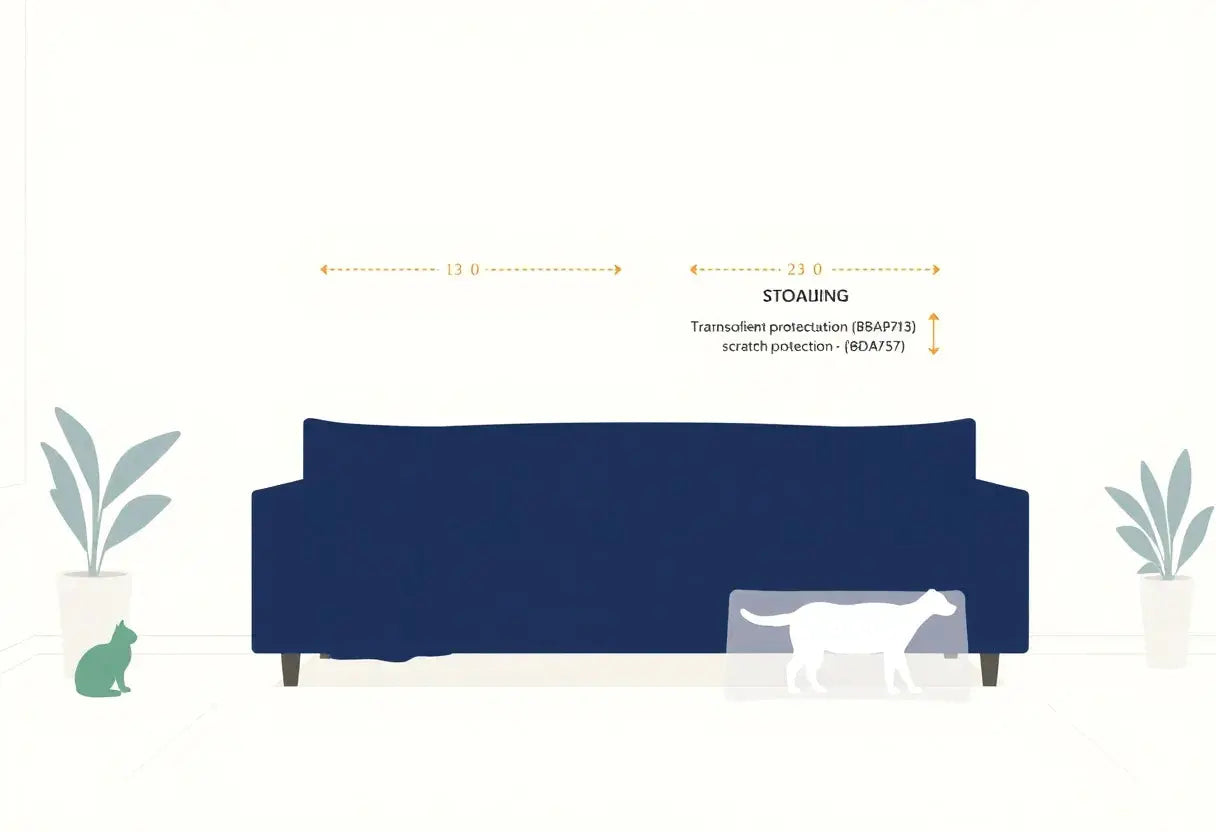
Mini diagram (quick visual reference)
Use these labels in your notes so nothing gets mixed up:
- A: Overall width (outer arm to outer arm)
- B: Seat depth (front edge of seat to where it meets the back cushions)
- C: Back height (floor to top of back)
Alt text suggestion for your main image: Mini diagram showing sofa measuring points A outer arm to outer arm, B seat depth, C back height for a made-to-measure sofa cover measuring guide.
1) Overall width (A): outer arm to outer arm
What to do:
Measure straight across the front of the sofa from the outer edge of one arm to the outer edge of the other arm.
Why it matters:
Overall width is one of the first measurements used to size a made-to-measure pattern. If it is short by even a little, the cover can pull at the arms and shift when someone sits down.
Family and pet tip:
If your arms are rounded or rolled, measure at the widest point (still outer edge to outer edge). This helps prevent that tight, climbing-up-the-arm look that makes a stain-resistant sofa cover feel less tidy.
2) Overall depth: front seat edge to the very back (include any protruding frame)
What to do:
Measure from the front edge of the seat straight back to the back of the sofa. If the back frame sticks out behind the cushions, include it.
Why it matters:
Depth controls how the cover wraps and anchors. Accurate depth is especially important for a pet-friendly couch cover because it helps reduce loose fabric where claws can catch and where hair likes to collect.
Quick check:
If your sofa sits close to a wall, slide it out just enough to measure the true back depth cleanly.
3) Back height (C): floor to top of backrest (plus backrest-only if requested)
What to do (full-drop styles):
Measure from the floor to the top of the backrest.
Optional but helpful:
Also record the backrest-only height (from the seat level up to the top of the back). Some custom orders or styles use this to fine-tune a more tailored look.
Why it matters:
Back height determines coverage and drape. If you want a more protective, family-proof look (and a little extra help hiding everyday scuffs), this is the measurement that makes “full coverage” actually feel finished.
4) Seat area: seat width and seat depth (the comfort zone measurements)
These two measurements help the cover look sleek where you see it and use it most.
Seat width:
Measure inside arm to inside arm across the seating area.
Seat depth (B):
Measure from the front edge of the seat back to where the seat meets the back cushions (or the backrest if cushions are attached).
Why it matters:
The seat area is where slipping and bunching shows up first. Getting seat width and depth right is a major factor in a custom slipcover fit that stays calm and smooth, even with daily lounging.
Pro tip for accuracy:
Keep the tape level and straight. If you measure at an angle, you will accidentally add extra length and end up with excess fabric pooling at the seat front edge.
5) Arm dimensions: arm height and arm width (small numbers, big difference)
Arms take the most abuse in real homes: hands, snacks, sleepy heads, and excited paws. If you are investing in a stain-resistant sofa cover or a pet-friendly couch cover, arms are not the place to guess.
Arm height:
Measure from the floor to the top of the arm.
Arm width:
Measure from the outside of the arm to the inside of the arm (outer edge to inner edge).
Why it matters:
Arm width affects how neatly the cover wraps and whether it stays in place. Arm height affects whether the cover looks tailored or looks like it is “floating” above the arm.
High-wear zone note:
If your arm tops are your main spill and scratch hotspot, you may want to add dedicated pieces for easier washing. See Armrest and Cushion Covers for options that make high-traffic areas simpler to protect without re-covering the entire sofa every time.
6) Skirt or drop length: where you want the cover to end
What to do:
Decide where you want the cover to finish, then measure from the seat or frame edge down to that point.
Common choices:
- Just below the frame for a clean, modern look
- Mid-leg to soften the silhouette
- Near the floor for maximum coverage (great for hiding pet hair, little scuffs, or toy marks)
Why it matters:
Drop length is the styling detail that makes your sofa feel intentionally dressed, not simply “covered.” It is also practical: a slightly longer drop can keep the area under the sofa looking tidier in family homes.
Quick recap: copy this checklist into your notes
- A Overall width (outer arm to outer arm)
- Overall depth (front seat edge to very back, include protruding back frame)
- C Back height (floor to top of backrest, plus backrest-only height if needed)
- Seat width (inside arm to inside arm)
- B Seat depth (front edge to where seat meets back cushions)
- Arm height (floor to top of arm)
- Arm width (outside to inside)
- Skirt or drop length (frame or seat edge down to desired end point)
With these core measurements done, you have the “skeleton” of your order. Next, we will make everything look truly polished by measuring cushions the easy way, so your cover looks smooth and tailored rather than puffy or loose.
Measuring Cushions the Easy Way (So Everything Looks Smooth, Not Puffy)
If the frame measurements are the “skeleton,” your cushions are the “tailoring.” In this made-to-measure sofa cover measuring guide, cushions are where a custom slipcover fit can look effortlessly chic or suddenly look a bit… lumpy. The good news: once you know what to record (and in what order), measuring is quick and very repeatable.
Below is the simplest, most reliable way to handle cushions when you are learning how to measure a sofa for a custom cover.
1) Seat cushions: measure all three dimensions (and measure each cushion separately)
For every seat cushion, record:
- Width: left to right across the front face of the cushion
- Depth: front to back (the length you sit on)
- Thickness: top surface down to the bottom seam
Actionable tip: Measure cushion thickness at the side seam, not in the middle where the fill can dome slightly. This helps the cover sit smooth instead of pulling at the edges.
Important reality check: Cushions are often not identical, especially on sofas that have had years of “favorite spot” sitting, or on sectionals where one seat is slightly wider. Treat each cushion as its own item, even if they look the same at first glance.
Why this matters (common mismatch): When people skip thickness, the cover has to “guess” how tall the cushion is. Even a small difference can create wrinkling, shifting, or tight seams, especially with a structured, tailored look.
2) Back cushions: note the style, then measure width, height, thickness
Back cushions usually come in a few common shapes. Before you measure, quickly note which you have:
- T-cushions (a “T” shape that wraps around the arm area)
- Boxed-edge cushions (more structured, squared edges)
- Loose pillow style (softer, more flexible shape)
Then record for each back cushion:
- Width
- Height
- Thickness
Practical tip for busy homes: If your back cushions are very “squishy,” press them gently to their natural shape before measuring. Do not compress them hard. You want everyday reality, not a flattened cushion that will pop back up later.
3) Attached cushions: measure what you can see, and use photos as your backup
If your seat or back cushions are attached (fixed in place), you cannot measure all sides like a removable cushion, and that is completely fine.
Do this instead:
- Measure the visible panel area (the face you can see)
- Measure along seams you can access (top seam, side seam, and the seam where the cushion meets the frame)
- Take two quick photos:
- One straight on (front view)
- One from the side (profile view)
Those photos become your “memory” later, especially when you are ordering more than one piece or coming back to reorder after a wash-and-wear test.
4) Pet owner example: plan for the “favorite cushion” and speed up laundry day
If your dog curls up on the same cushion every single day (you know the one), you can make life easier:
- Measure that cushion carefully
- Consider ordering an extra removable cover for that cushion so you can rotate covers during muddy season, shedding weeks, or after a surprise snack spill
This little strategy pairs beautifully with a pet-friendly couch cover approach: you keep the sofa looking tidy while staying realistic about daily life.
If you want to protect only the most used spots first (seat cushions take the most action), you can also explore dedicated options here: Sofa Seat Covers.
5) Pro tip that prevents ordering errors: record inches and centimeters
To avoid conversion mistakes, write measurements in both inches and centimeters in your notes. It takes an extra minute and can save you from ordering the right cover in the wrong unit.
A simple format that works:
- Seat Cushion 1: 24 in W x 22 in D x 6 in T (61 cm x 56 cm x 15 cm)
Quick measurement examples (copy this template)
- Seat cushion A: Width ___ / Depth ___ / Thickness ___
- Seat cushion B: Width ___ / Depth ___ / Thickness ___
- Back cushion A: Width ___ / Height ___ / Thickness ___ / Style: ___
- Back cushion B: Width ___ / Height ___ / Thickness ___ / Style: ___
- Attached cushion notes: Visible panel ___ / Seam lengths ___ / Photos taken: front + side
With cushions measured, you have the details that make a stain-resistant sofa cover look fitted, not baggy, and help it stay neat when kids bounce, guests perch, or pets circle three times before settling in.
Next, we will tackle the pieces that feel trickiest at first glance: sectionals, recliners, chaises, and odd shapes, so you can measure confidently without guessing.

Sectionals, Recliners, and Odd Shapes: How to Measure Without Guessing
If your sofa is anything but a simple rectangle, you are not alone. Sectionals, recliners, chaises, and “designer” arms are exactly where most measuring mistakes happen, and they are also where a made-to-measure cover looks the most impressive when it fits correctly. The trick is simple (and very French in spirit): break the piece into calm, sensible parts, measure each part, then add clear notes so your custom slipcover fit looks tailored instead of “close enough.”
Below is a practical approach you can use right now, whether you are following this made-to-measure sofa cover measuring guide at home with kids underfoot or measuring seating in a busy lobby.
The golden rule: measure modules, not the entire silhouette
When people search how to measure a sofa for a custom cover for a sectional or an odd shape, they often try to measure the whole thing in one go. That usually leads to tape-measure gymnastics and numbers that do not reflect real seams and panels.
Callout: “Measure each module”
- If the sofa can be visualized as separate seats (left, corner, right), measure those sections as if each were its own small sofa.
- Write each module name on a sticky note (Left, Corner, Right, Chaise) and photograph it in place, so your notes match your photos later.
This one habit reduces errors because covers are built around panels and sections, not around a single extra-long outline.
Sectionals and L-shaped sofas: measure each section plus the corner connection
For an L-shaped sectional, treat it like three pieces:
- Left section
- Corner section
- Right section
For each section, capture the core measurements you already took earlier (width, depth, back height, arm details if present). Then add one measurement that people forget:
Connecting depth at the corner
- Measure from the inside corner point (where the two sections meet) out to the front edge on each side.
- This tells you how the “L” actually projects into the room and prevents a cover that pulls tight at the bend.
If you are shopping specifically for sectional options, this collection is a helpful next step once you have your module numbers: Sectional & L-Shaped Sofa Covers
Sectional measuring table layout (copy and fill in)
Use a simple table like this in your notes app so nothing gets missed:
| Module | Outer width | Seat depth | Overall depth | Back height | Arm type (if any) | Corner connect depth |
|---|---|---|---|---|---|---|
| Left piece | ||||||
| Corner piece | N/A or describe | |||||
| Right piece |
Tip: If your sectional has one arm on only one end, note which end (for example, “Left module has arm on the outside-left only”). Small details like this are what create that smooth, custom slipcover fit.
Chaise section: measure the long seat depth separately
A chaise is where “depth” becomes two different numbers, and mixing them up is a classic reason a cover looks rumpled at the front edge.
Take these two measurements:
- Main seat depth (where people sit upright, from front seat edge to back cushion area)
- Chaise seat depth (the long lounge depth, from the very front edge of the chaise to the back cushion area)
If your chaise cushion is a single long piece, measure it as its own cushion too (width, depth, thickness). This is especially helpful if you want a stain-resistant sofa cover that stays neat where snacks, feet, and paws tend to land most often.
Recliners: measure with the footrest closed and plan for moving parts
Recliners feel intimidating, but they are straightforward if you measure them in the “neutral” position.
Do this:
- Measure with the footrest closed.
- Note whether the back is attached (fixed) or if it reclines independently.
- Record clearance zones: where the recliner needs space to move without pulling the cover (typically behind the back and around the footrest seam).
Why it matters: A cover that is too tight around moving parts can shift every time someone reclines, which is frustrating in a family room and even more so in a media room or shared space.
Quick note for pet owners: recliners often collect hair and claw marks along the seat front edge and arm fronts. If you are choosing a pet-friendly couch cover, measuring those areas carefully helps the cover stay smooth right where pets jump up.
Odd arms (rolled, track, winged): measure the widest points and describe the shape
Arms are not just “an arm.” Rolled arms bulge. Track arms are crisp and squared. Winged arms flare. If you measure only at one point, the cover can pinch or bubble.
Measure like this:
- Arm width at the widest point (often the outer curve of a rolled arm)
- Arm height (floor to top of arm, and optionally seat-to-top if that is how your previous notes are structured)
- Arm length (front of arm to where it meets the back)
Then add one plain-language note in your order notes, such as:
- “Rolled arm, widest at mid-arm”
- “Track arms, square front”
- “Winged arm, flares outward near the top”
These notes take 10 seconds and can save you from a cover that looks slightly “off” even when the numbers are close.
Small business tip: measure traffic stress areas so covers stay tidy under heavy use
If you are measuring seating for a coworking space, waiting room, or lobby, the goal is not only protection. It is also maintaining a tidy look all day, even with constant sit down, stand up, and bag-on-arm action.
Add these two “stress area” measurements to your sheet:
- Arm fronts (top to bottom and side-to-side on the front face): this is where hands, watches, and tote bags rub repeatedly.
- Seat front edge (the front band of the seat where people slide in and out): measure the length across and note the height of the band if it is pronounced.
Why this works: when a cover is cut and tensioned correctly at these points, it is far more likely to stay neat, which supports a professional look and reduces fussing between cleanings.
Smooth handoff to the next step: fit is numbers plus fabric
Once you have your modules, moving parts, and widest points recorded, you have done the hardest part of how to measure a sofa for a custom cover. Next, we will make sure those good measurements turn into real-life protection by choosing materials and features that handle spills, scratches, and weekly wash cycles without losing that chic, tailored finish.
Fit + Fabric Choices That Make Protection Last (Stains, Scratches, and Daily Life)
A long-lasting cover is really a two-part promise: a precise fit, plus a fabric that can handle real life. Your measurements do the “tailoring” part (that is why this made-to-measure sofa cover measuring guide matters), but your fabric choice determines how the cover behaves after the 10th wash, the 100th sit, and the inevitable spill.
If you are using this guide on how to measure a sofa for a custom cover, keep this in mind: accurate numbers help you achieve a clean custom slipcover fit, but the right textile is what keeps that fit looking fresh instead of tired.
Start with fit, then choose fabric for your lifestyle
Think of it like dressing the family: the correct size comes first, then you pick the material that suits the day.
- If the cover is too loose, it may look relaxed at first, but it can shift, wrinkle, and invite crumbs and pet hair to collect in folds.
- If the cover is too tight, seams are under constant tension and can stress the sofa’s original upholstery underneath, especially on premium or vintage pieces.
A helpful rule: aim for a tailored look that still lets you slip your hand between fabric and sofa in tight spots (arms and corners) without forcing it.
Fabric priorities by household type (simple, practical, chic)
Busy families (kids, snacks, movie nights)
Look for fabrics that forgive the everyday.
- Washable and quick-dry: If you are washing weekly, a fabric that dries fast keeps life moving (and keeps you from “living with the bare sofa”).
- Darker tones or textured weaves: These help disguise tiny marks between washes. A soft heathered look, a subtle basket weave, or a lightly patterned neutral can be very French chic and very practical.
- Stain-resistant sofa cover benefits: Stain resistance helps buy you time. You still want to blot spills quickly, but you are less likely to be left with a permanent reminder of juice or sauce.
Tip: If your measuring notes show high-risk zones (arm tops, seat front edge), consider planning extra protection there with separate armrest or cushion pieces, so the most-used parts get the most wash cycles.
Pet owners (claws, zoomies, fur, and naps)
Here, the weave matters as much as the fit.
- Tighter weaves = fewer snags: A tight weave gives claws less to grab and helps reduce pulled threads.
- Scratch-resistant surfaces: Not scratch-proof (nothing truly is), but you can choose fabrics designed to resist snagging and surface wear better than loose weaves.
- Hair visibility: Smooth fabrics can show hair more clearly, while some textures help it blend in. If your pet is light and your sofa is dark (or vice versa), choose a mid-tone or textured fabric to make fur less obvious between cleanings.
If you are specifically shopping for a pet-friendly couch cover, you will usually be happiest with a snug, neat fit plus a fabric built for abrasion and easy upkeep. You can explore options here: Anti-Scratch Couch Covers.
Décor lovers (refresh the room without replacing the sofa)
A made-to-measure cover is one of the most satisfying “new sofa” moments without the new sofa price or waste.
- Seasonal swaps: Light neutrals for spring and summer, deeper tones for autumn and winter.
- Layered neutrals: Cream, oatmeal, stone, and greige can look elevated and intentional when you mix textures (for example, a smooth base with a more tactile cushion cover).
- Texture as a style tool: If your sofa has clean lines, a textured weave adds warmth. If your sofa is already detailed, a simpler fabric keeps it sophisticated.
Premium or vintage sofas (protect, but let the piece breathe)
With heirloom or high-end upholstery, the goal is protection without pressure.
- Choose breathable materials: You want airflow so the original upholstery is not trapped under a “sealed” feel for long periods.
- Avoid overly tight tension: If your measurements are right but you choose a fabric with very little give, it can pull hard at corners and piping. A secure fit should look smooth, not strained.
Quick comparison table: choose your “best fit” fabric personality
Use this as a practical snapshot while you decide. (Your exact fabric options will vary, but these categories make choosing easier.)
| Fabric type (common category) | Washability | Texture feel | Hair visibility | Scratch resistance | Style level |
|---|---|---|---|---|---|
| Tight weave (canvas, twill style) | High | Structured, crisp | Medium | High | Clean, tailored |
| Microfiber or suede-like | High | Soft, cozy | Medium to high (depends on color) | Medium | Warm, family-friendly |
| Textured weave (basket, heathered) | Medium to high | Tactile, forgiving | Lower | Medium | Very chic, hides life well |
| Velvet-like plush | Medium | Luxurious, rich | Higher | Lower to medium | Statement, elegant |
| Linen-look blends | Medium | Airy, relaxed | Medium | Medium | Effortless French charm |
Small decision shortcut:
- If you want the most “set it and forget it” protection, lean toward tight weaves or textured weaves.
- If your priority is a glam refresh, go plush, but be more vigilant with pets and high-friction areas.
How fit and fabric work together (so your cover stays neat)
When you measure carefully (outer arm to outer arm, seat depth, arm height, and cushion thickness), you are setting yourself up for a custom slipcover fit that does not migrate. Then fabric choice determines whether that fit stays looking polished after repeated use:
- Wash-heavy household? Choose a fabric that keeps its shape through cycles.
- Pets? Choose a weave that resists snagging and reduces hair cling.
- Vintage sofa? Choose breathable comfort and a fit that protects without squeezing.
Up next, we will bring this all together with practical “final checks” so your measurements, fit, and fabric choice translate into a cover that looks tailored the day it arrives and still looks lovely weeks later.

You’ve done the careful work of measuring your sofa, cushion by cushion, arm by arm, and now you know exactly what your piece needs for a chic, lasting fit. This made-to-measure sofa cover measuring guide showed you how to measure a sofa for a custom cover with confidence, turning a potentially frustrating task into a calm, foolproof process. Whether you chose a stain-resistant sofa cover for snack time or a pet-friendly couch cover for muddy paws, the secret to a custom slipcover fit that stays put lies in those precise numbers and the right fabric choice. Your home deserves protection that looks intentional, not hurried.
Ready for a cover that looks tailored and stands up to real life? Measure your sofa today (use the checklist above), then explore FrenchCovers options designed for a neat fit and easy care—so your living room stays chic and protected this week. Because a well-dressed sofa means more room for the moments that matter most.
Measuring FAQs for a Chic, Stay Put Custom Fit
Measuring can feel like the hardest part, but our made-to-measure sofa cover measuring guide breaks it into quick, family-proof steps for a custom slipcover fit that looks tailored and stays put. Below are the most common questions we hear from busy homes, pet lovers, and anyone protecting premium or vintage seating with a stain-resistant sofa cover.
Q: How do I measure my sofa if the cushions are attached? A: Treat attached cushions as part of the sofa body and measure over them, following our how to measure a sofa for a custom cover steps: total width, seat depth, back height, and arm width. This is the easiest way to get a snug custom slipcover fit that looks neat and performs like a pet-friendly couch cover. See Measuring When Cushions Are Attached.
Q: Should I measure with the cushions on or off? A: Measure the way you actually use your sofa, typically with cushions on and fluffed as in daily life, as noted in the measuring checklist from the article. This helps your stain-resistant sofa cover sit smoothly and reduces shifting for an everyday, lived-in look. See Cushions On vs Off: What We Recommend.
Q: What if my sofa measurements fall between two sizes? A: In our made-to-measure sofa cover measuring guide, we recommend choosing the size that matches your largest measurement point so the cover is not pulled too tight. A slightly roomier cover can be refined for a cleaner custom slipcover fit, while a too-small cover tends to slip and strain, especially in pet-friendly couch cover situations. See What to Do if You Are Between Sizes.
Q: How do I measure an L-shaped sectional or a sofa with a chaise? A: Measure each section separately, then note the full length from the outer arm to the end of the chaise, plus the depth of the chaise seat, as outlined in the sectional section of the article. This approach makes how to measure a sofa for a custom cover much simpler and delivers a tailored, stain-resistant sofa cover fit across every angle. See Sectionals and Chaise Measuring Steps.
Q: What measurements matter most for a cover that won’t slip with kids or pets? A: Prioritize seat depth, back height, and arm width, since these anchor points help prevent shifting, a key tip from the article for active households. Accurate numbers here are the secret to a secure custom slipcover fit and a truly pet-friendly couch cover that stays chic even after zoomies and snack time. See Slip-Resistant Measuring Priorities.