You measured your couch, ordered a cover labeled for sectionals, and it arrived looking nothing like the photo. One end swims in loose fabric, the chaise sits bare, and the corner bunches into a ridge no amount of tugging will flatten. It is one of the most common complaints about sectional sofa covers, and it is almost never a fabric problem. It is a sizing problem, and more precisely a counting problem: most L-shaped couches need two covers, not one.
Once you know that, the rest is straightforward. This guide walks through the one measurement that decides your size, a chart that translates it into the sizes you will actually see on a product page, and the configuration rules for chaise ends, U-shapes and reclining frames. It also explains why a two-piece cover gives a cleaner result than any single seamless panel. Budget five minutes with a tape measure and you will order once instead of twice.

Why one cover rarely fits an L-shaped couch
Straight sofas are easy to standardize. Length varies, but the shape does not. An L-shaped sectional is a different object entirely: the chaise can run 55 inches or 75, the corner seat can be square or wedge-shaped, the arms can be thick rolled bolsters or a flat 4-inch panel. Two sofas with identical overall footprints can need completely different amounts of fabric.
A single seamless L-shaped cover would have to match your exact corner geometry to sit flat. Make it for one sofa and it gapes on the next. That is why the industry settled on a modular approach instead, and why it works better than it sounds.
Think of your sectional as two straight sofas that happen to meet at a right angle. Cover each one on its own terms. The long run gets a cover sized to the long run, the chaise gets a cover sized to the chaise, and the two pieces overlap where they meet. The corner seat swallows the join, so the seam disappears into the crevice rather than sitting on display.
This is also why sectional sofa covers are listed by seat count rather than by sofa shape. The listing is not describing your whole couch. It is describing one section of it, which is the only unit a slipcover can be cut to reliably.
Measure your sectional in five minutes
Sizing sectional sofa covers correctly starts with a tape measure, not a product page. The whole process takes less time than browsing colors.
What you need before you start
A soft tailor's tape, the kind used for sewing. A rigid carpenter's tape will not follow the curve of a sofa back, and that curve is precisely what you are trying to capture. If you only have a metal tape, use a length of string instead and lay it flat against a ruler afterwards. Keep your phone handy to note the numbers as you go, because you will be taking more than one.
Clear the sofa first. Remove throw pillows, blankets and anything tucked into the seams. A cushion left in place can add two inches to a reading and push you into the wrong size bracket.
The one measurement that decides your size
Measure the width across the back of each section, from the outer edge of one arm to the outer edge of the other arm. Run the tape along the surface of the sofa, following the contour of the back, not in a straight line through the air. On a curved or rolled back this difference can reach several inches.
Do this once for the long run and once for the chaise run. On the long run, the tape starts at the outside face of the free arm and finishes where the section ends at the corner. On the chaise run, it starts at the corner and finishes at the outside face of the far arm or, if the chaise has no arm, at the outer edge of the frame.
Those two numbers are your sizes. Everything else is confirmation.
Two more numbers worth writing down
Seat depth, measured from the front edge of the seat to the base of the back cushion, tells you whether there will be enough fabric left to tuck. Anything past 24 inches is a deep sofa and benefits from sizing up. Arm width, measured across the top of the arm, tells you how hard the elastic will have to work. Wide rolled arms above 12 inches consume noticeably more fabric than slim track arms.
Neither number changes which size you order in most cases. Both of them settle the question when you are hesitating between two.
Five measuring mistakes that cause returns
- Measuring the seat cushions instead of arm to arm. The cushions are always shorter than the frame. This is the mistake that sends people one full size down.
- Pulling the tape in a straight line. Fabric has to travel over the back, not through it. Follow the surface.
- Counting the corner seat twice. The corner belongs to one run only. Decide which section owns it before you measure, and stay consistent.
- Measuring with the pillows in. Strip the sofa down to its frame and fixed cushions first.
- Rounding down to save money. A cover at the very top of its range is a cover that will slip within a week.
The sizing chart for sectional sofa covers
Every one of our sectional sofa covers uses the same four-step scale. The labels differ slightly between products, some say "3 Seat" and others say "Three People" or simply give the centimeter range, but the brackets underneath are identical, and they all key off the same arm-to-arm width.
| Cover size | Arm-to-arm width (inches) | Arm-to-arm width (cm) | What it usually covers |
|---|---|---|---|
| 1 Seat / Single | 35 to 55 in | 90 to 140 cm | A short corner return, a single recliner seat, or a matching armchair |
| 2 Seat / Loveseat | 57 to 73 in | 145 to 185 cm | The short arm of most L-shaped couches, including the chaise run |
| 3 Seat | 75 to 91 in | 190 to 230 cm | The long run of a standard L-shaped sectional |
| 4 Seat | 93 to 118 in | 235 to 300 cm | Oversized long runs and the straight sides of large U-shaped sofas |
How to read the chart
Find the row your arm-to-arm measurement falls into and order that size for that section. Then repeat for your second section. A typical American L-shaped sectional lands on a 3 Seat cover for the long run and a 2 Seat cover for the chaise, so that is the pairing to check first in the sectional and L-shaped sofa cover range.
Worked example. Your long run measures 84 inches arm to corner, which is 213 cm. That sits inside the 190 to 230 cm bracket, so it takes a 3 Seat cover. Your chaise measures 63 inches, or 160 cm, which falls in the 145 to 185 cm bracket and takes a 2 Seat cover. You order one of each, in the same color and the same product line.

Sectional Couch Cover Stretchable Printed ELOISEA
Sizes labeled by seat count and width: 90x140 cm, 145x185 cm, 190x230 cm, 235x300 cm.

Corner Sofa Cover Minimalist Soft LUNETTE
Single, Double, Three People and Four People sizes in 22 solid colors.

Corner Sofa Cover Stretchable Pet-Friendly LUMIEL
Sold as 1, 2, 3 or 4 seat bundles with two pillowcases included.

Corner Sofa Cover Velvet Stretchable LUMIÈRE
Velvet finish in four widths, from 90-140 cm up to 235-300 cm.
What to do when you fall between two sizes
Sizes overlap at the edges by design, and the brackets are continuous: 140 cm ends one and 145 cm begins the next. If you measure 142 cm you are in the gap, and the answer is to take the larger size every time.
The reasoning is mechanical rather than cosmetic. A slipcover stays put because surplus fabric is wedged into the crevice between seat and back, where friction holds it. Order the smaller size and there is no surplus to wedge. The cover sits on the sofa like a drum skin, every movement pulls at the elastic hem, and by the second evening the arms have crept up. Order the larger size and you gain two to three inches of tuckable fabric per edge, which is exactly what you need.
Match the chart to your sectional configuration
The two-piece L-shape
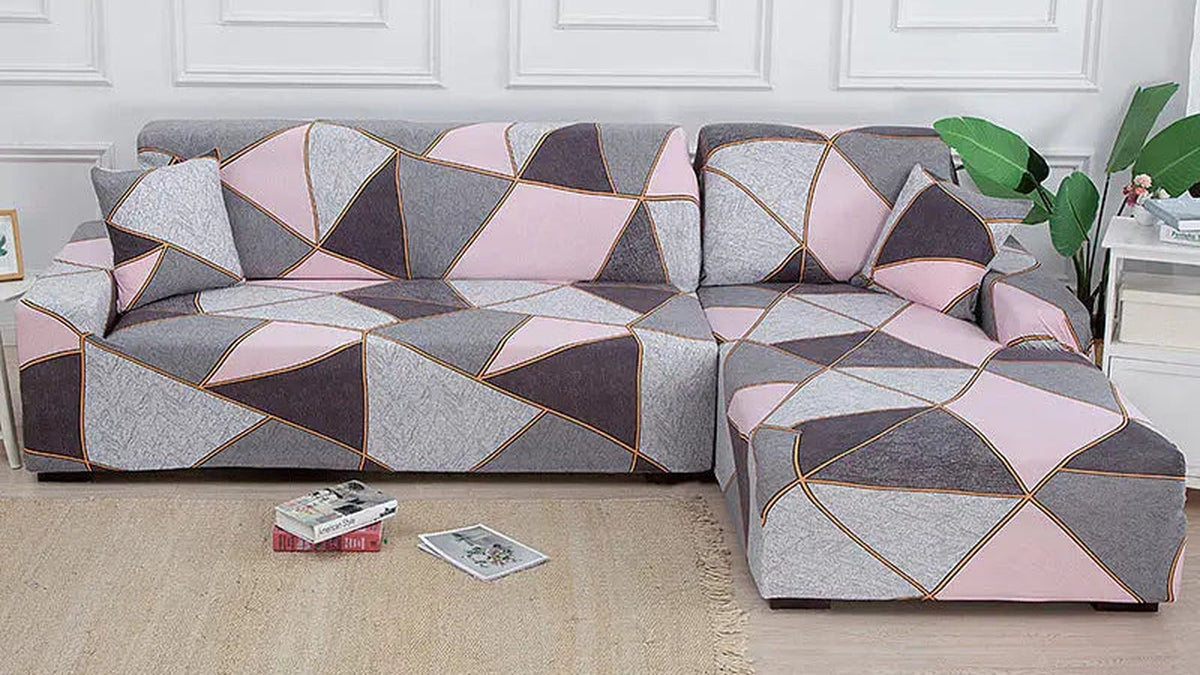
The standard case, and the one the chart is built around. A two-piece cover set means one cover per run, ordered together so the dye lots match. Fit the long run first, tuck it fully, then fit the chaise piece so its edge overlaps the first by a few inches. Push that corner overlap down into the crevice and the join becomes invisible.
Chaise on the left or the right
For tailored, cut-to-shape covers this is a critical specification. For the stretch covers in our range it is mostly a non-issue, because each section is covered independently and the pieces are symmetrical. What matters is knowing which run is long and which is short, not which hand they fall on.
If a listing does specify orientation, check its wording before you order. Some manufacturers define left and right from a seated position and others from the viewer standing in the room, and the two conventions produce opposite answers.
U-shaped and three-piece sectionals
Same method, three covers. Measure each straight run separately, assign each corner seat to one run only, and work around the sofa in order so nothing gets counted twice. A U-shaped sectional frequently needs a 4 Seat cover for the central run, and a handful of sectional sofa covers in the range go as far as 310 cm, or 122 inches, for genuinely oversized frames.

Reclining sectionals
A reclining seat is a moving target. Measure it fully closed, then size up one step to give the mechanism room to work. The footrest needs somewhere to go, and a cover cut to the closed dimension will bind the moment the chair opens. Expect to re-tuck a reclining section more often than a fixed one. Covers shaped specifically for reclining frames, like those in the recliner sofa cover range, handle the movement better than a general-purpose sofa cover.
The chaise or lounger end
A chaise section with no outer arm is a different shape from a two-seat run, and a dedicated single-piece slipcover fits it more cleanly than a standard loveseat cover. The Chaise Lounge Slipcover Stretch Pet-Friendly LUMIELA is built for exactly this section and comes in 32 colorways, with the option of a matching pillowcase.

How much stretch you actually get
A stretch slipcover is typically built from a spandex polyester blend, and the spandex content is what gives it grip. The elasticity is real: a cover will pull over an arm noticeably wider than its nominal size. That capability tempts people into treating stretch as a substitute for measuring. It is not.
Stretch is there to handle shape, not length. It lets one flat piece of fabric wrap a rolled arm, a sloped back and a curved corner without darts or seams. Spend that elasticity on covering distance instead and three things go wrong at once.
The weave opens up, so the color goes pale and the pattern distorts. The fabric thins where tension is highest, usually across the arm tops, and wears through there first. And the elastic hem, already at full extension, stops pulling the skirt in underneath the frame.
Fabric choice changes the margin a little. Velvet and plush have more body and recover their shape well after being stretched. Lightweight printed jacquards move more easily but also show tension lines sooner. Neither difference is large enough to justify dropping a size.
Breathability deserves a mention here too, because a tightly stretched cover traps more moisture against the upholstery underneath. Our guide to breathable sofa covers and mold prevention covers what to watch for, particularly on sofas that sit against an exterior wall.
When the size is right but the cover still shifts
Tuck depth is doing most of the work
A correctly sized cover that slides around has almost always been under-tucked. Work along the seat crevice and push the surplus fabric down as far as your hand will reach, two to three inches at minimum. Anti-slip foam grips, or a twisted tuck strip made from an old towel, wedge into the same channel and hold the fabric there permanently. On sectionals used daily by children or dogs, this single step makes more difference than any other adjustment.
Closing the gap at the corner
The corner is where two pieces meet, so it is the one place the fit depends on installation rather than sizing. Lay the second cover generously over the first, never butt them edge to edge, and position the join behind the corner seat cushion rather than in front of it. If a gap still opens when someone sits down, your corner overlap is too shallow and you need to pull more fabric across from the longer run.
Washing without losing the fit
Elastic is the part of a slipcover that ages, and heat is what ages it. Wash cold, and either line dry or tumble on the lowest setting. If the care symbols on your cover label are unfamiliar, the FTC care labeling rule explains what each one legally means. A single hot cycle can shrink an elastic hem enough to move a cover from comfortable to strained, at which point a correctly sized cover starts behaving like an undersized one. Zippers and seams take the strain first, and our guide on repairing a torn sofa cover explains how to catch that damage early.
Pets, spills and the waterproof question
Households with animals usually want water resistance on top of a good fit, and the two requirements can pull against each other: heavier coated fabrics stretch less. Size up if you are choosing a waterproof model, and read our note on the mistake that makes waterproof covers trap moisture before you buy. The pet furniture protection range groups the options built for claws and fur.
Why choose French Covers?
All of our sectional sofa covers use the same four-step size scale, which means you can compare products without relearning a chart each time. Size ranges are published on each listing in centimeters and translate directly to the table above, and most designs carry the full 1 to 4 seat span so both halves of an L-shape can come from one product line in one color.
- Sectional Couch Cover Stretchable Printed ELOISEA - 15 printed designs, with sizes labeled directly by seat count and width so there is nothing to convert.
- Corner Sofa Cover Stretchable Pet-Friendly LUMIEL - sold as seat-count bundles with two matching pillowcases, built for households with animals.
- Corner Sofa Cover Minimalist Soft LUNETTE - 22 solid colors across Single to Four People sizes, for a plain finish without a pattern to align.
Browse the full sectional and L-shaped sofa cover collection to compare every size and finish side by side.
Frequently asked questions
Do I need one cover or two for an L-shaped sectional?
Two, in almost every case. Sectional sofa covers are sold per section, so an L-shaped couch needs one for each of its two straight runs. Measure the long side and the short side separately, then order the size that matches each one. The two pieces meet at the corner, where the overlap is tucked out of sight. A three-piece or U-shaped sofa follows the same logic with three covers.
How do I know whether my chaise is left-facing or right-facing?
Stand in the room and look at the sofa. Note which side the chaise extends toward, then check how the listing defines it, because some brands describe orientation from a seated position and others from the viewer's position. With the stretch covers in our sectional range, this matters far less: each section is covered independently, so the same cover works on either side of the corner.
My measurement falls between two sizes. Which one should I order?
Go up. A cover stretched to its absolute limit loses its recovery, thins out over the arms and pulls itself loose every time someone sits down. The larger size leaves you extra fabric to push into the seat crevice, which is what actually holds a slipcover in place. A 188 cm run, for example, belongs in the 190 to 230 cm size rather than the 145 to 185 cm one.
Will a stretch cover work on a reclining sectional?
Yes, with two conditions. Measure the sofa fully closed, and accept that the cover needs to be re-tucked after heavy use. A reclining seat changes shape as the footrest rises, so the fabric has to travel with it. Sizing up by one step gives the mechanism the slack it needs. Covers cut specifically for recliner frames handle this better than a general sofa cover.
Can I use two different colors on the same sectional?
You can, and it is a deliberate look in plenty of living rooms: a darker tone on the long run where people sit most, a lighter one on the chaise. Just buy both pieces from the same product so the fabric weight, weave and sheen match. Two grays from two different ranges rarely read as the same gray once they are side by side under daylight.
Why are the sizes listed in centimeters?
Sectional sofa covers follow a global sizing standard built around the width of a sofa back in centimeters, so the labels stay in that unit across every brand. The conversion is simple: divide centimeters by 2.54 to get inches. A 190 to 230 cm cover is a 75 to 91 inch cover, which fits the long side of most American sectionals.
Getting sectional sofa covers to fit comes down to one habit: stop thinking about your couch as a single L and start thinking about it as two separate runs. Measure each one arm to arm across the back, match the number to the chart, round up when you are between brackets, and tuck the surplus deep into the crevice. Do that and the cover looks fitted on day one and still looks fitted six months later. When you are ready to order, the Corner Sofa Cover Stretchable Elastia covers the full 90 to 310 cm span and is a reliable starting point for either half of your sectional.