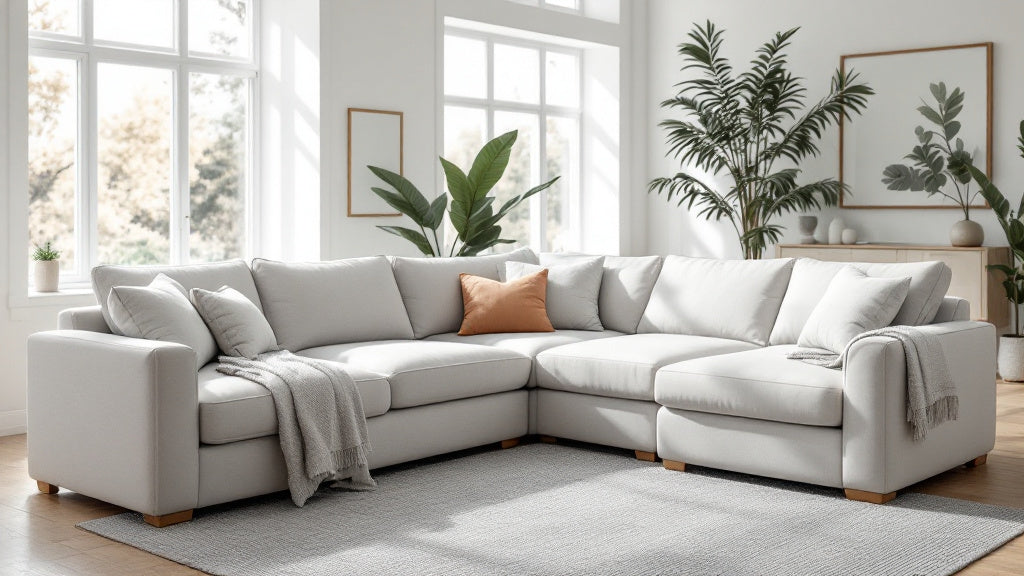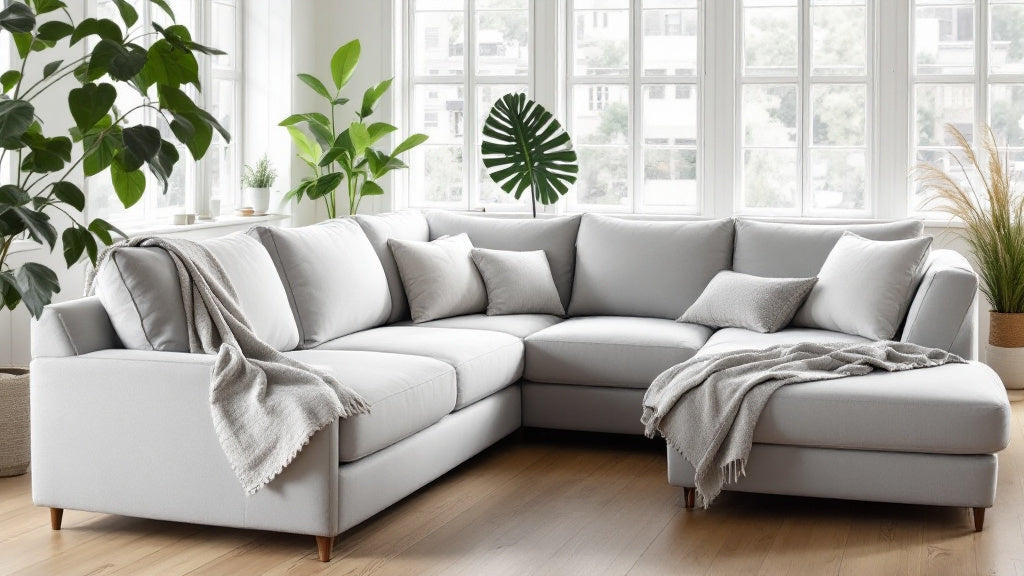
You buy a stretch cover for your L-shaped couch, pull it on, and the long seats look great. Then you reach the chaise. The fabric runs out halfway down the lounger, the open end gapes, and by Sunday evening the whole piece has crept toward the floor. That is not bad luck. Sectional covers with a chaise have to solve a different shape at that end, and most covers sold by seat count are not built for it.
This guide explains why the chaise behaves differently, how to tell a left-facing chaise from a right-facing one, which three measurements decide the fit, and which cover formats actually hold. You will also find a quick comparison of one-piece covers, separate chaise pieces and cushion-by-cushion sets, plus fitting steps that keep the long end tucked in after a movie night with the dog stretched across it.
If you have not measured your couch yet, keep a tape measure close. Ten minutes now saves a return later.

Why the chaise end breaks a standard sectional cover
A regular sofa is a repeating unit: seat, seat, seat, with an arm at each end. A chaise interrupts that pattern. It is the one section built for lying down rather than sitting up, and that changes three things a cover has to deal with.
The depth problem
Standard seat cushions on a sectional are roughly square. The chaise cushion is a long rectangle. Look at the size tables on our own seat covers: a regular seat size covers cushions about 55 to 89 cm (22 to 35 in) long, while the chaise size on the same product runs 155 to 195 cm (61 to 77 in) long and 90 to 110 cm (35 to 43 in) wide. That is roughly double the seat depth of every other seat on the couch.
A cover sized by back width only counts how wide the couch is. It has no idea that one section sticks out twice as far into the room. So the fabric that fits the long run perfectly simply runs short on the lounger.
The open end with no arm
Most chaises have no arm on the outer side, or only a low one. Arms are what a stretch cover grips to hold its shape. Without one, the elastic edge has nothing to hook onto at the foot of the chaise, so the fabric relaxes and drifts. This is also why an armless end often looks baggy even when the size is technically right.
Where the chaise meets the corner
The third weak spot is the joint between the chaise and the rest of the sectional. On many couches the chaise is a separate module pushed against the main run. The seam between them is a gap that swallows fabric, crumbs and fur. A cover that tries to bridge the joint gets pulled into it every time someone sits down. Treat the chaise and the main run as two jobs, then let the covers overlap at the corner.
Left-facing or right-facing: get the orientation right first
Before you measure anything, settle the orientation. Getting it wrong is the most common reason a chaise cover goes back in the box, especially with shaped covers and pet protectors that are cut to a specific layout.
The furniture industry convention is to describe the chaise as you face the couch. Stand in front of it, looking at the seats. If the chaise is on your left, it is a left-facing chaise, often written LAF (left arm facing). If it is on your right, it is right-facing, or RAF.
Stretch covers that wrap the whole frame usually work either way. Flat, quilted or tailored covers do not, because the long piece is cut on one side only.
That is why a cover like our left- and right-facing chaise sectional cover is sold in a Left version and a Right version, each with its own cushion length. Check the orientation on the listing photo, compare it to your living room, and only then pick the size. A few seconds here prevents the classic mistake of a lounger panel hanging off the wrong end.
How to measure a chaise for a cover
Once you know the orientation, the measuring itself is quick. You need a soft tape, a notepad and two minutes per section. For the full sectional, including the long run and the corner seat, our sizing guide for L-shaped couches walks through every number. Here we focus only on the chaise.
The three numbers that matter
- Chaise length: from the back of the backrest to the foot of the chaise, along the floor side. This is the number most covers fail on.
- Chaise width: across the cushion, from the corner joint to the outer edge of the frame (or the outside of the arm, if there is one).
- Cushion thickness: the height of the seat cushion. Shaped cushion covers list a thickness range, often 5 to 18 cm, and a deep foam pad can sit at the edge of it.
Write the numbers down in both inches and centimeters. Many cover sizes are listed in centimeters, and converting in the store page is where mistakes creep in.
Cushion size vs frame size
Decide what you are covering. A full slipcover goes over the frame, so it needs the outside dimensions, including the arm and the base. A cushion cover only dresses the seat pad, so it needs the cushion dimensions. On a chaise the two can differ by several inches, because the frame often extends past the cushion at the foot. Mixing the two sets of numbers is the fastest way to order a size that looks right on paper and fits badly in the room.
Sectional covers with a chaise: the options compared
With the measurements in hand, you can choose a format. There are four realistic routes for sectional covers with a chaise, and each suits a different couch and household.
| Cover type | How it handles the chaise | Best for | Watch out for |
|---|---|---|---|
| One-piece stretch L-cover | Stretch fabric wraps the chaise as part of the whole couch | Shorter chaises and a quick, full refresh | Can run short on very deep loungers |
| Two stretch covers (main run + chaise) | Each section gets its own size, overlapping at the corner | Modular sectionals with a detachable chaise | Order two sizes; match colors on both |
| Flat or quilted protector with a chaise piece | A long panel lies over the chaise, cut for left or right | Pets, kids and spill-heavy households | Orientation must match your couch |
| Cushion-by-cushion seat covers | A dedicated chaise-size cover hugs the long cushion | Couches with removable cushions you want to keep visible | Frame and arms stay exposed |
A one-piece option such as a one-piece stretch L-shaped couch cover is designed for L configurations with a chaise and works well when the lounger is not much deeper than the seats. Once the chaise is noticeably longer, a separate piece for that section usually gives a cleaner result.
One naming tip for cushion covers: some seat cover listings call the chaise size "Guifei" or "Imperial Concubine". It is a literal translation of the Chinese name for a chaise longue, and it is the size you want for the lounger cushion. Our stretch seat covers with a chaise-length size offer it in Regular and Extra Large, next to the standard single, double and triple seat sizes.
Fitting the chaise end so it stays put
The right size is half the job with sectional covers with a chaise. The other half is installation, because the chaise is where people stretch out, push with their feet and slide in and out. That movement pulls fabric toward the foot every single day.
Step-by-step fitting
- Fit the main run first and tuck it fully into the backrest crease.
- Place the chaise piece, starting at the corner, so it overlaps the main cover by a few inches.
- Smooth the fabric toward the foot of the chaise, never back toward the corner.
- Push the excess deep into the gap between the cushion and the frame along both long sides.
- Finish at the open end: wrap the elastic edge or straps under the base, not just around the cushion.
Stopping the slide toward the foot
If the cover still creeps, the fix is almost always tuck depth. Foam tuck-in sticks, or a rolled towel pushed into the crease, give the fabric something to hold against. A non-slip layer helps on leather and faux leather, where smooth stretch fabric glides easily. Covers with anti-slip backing grip better on the long cushion than plain polyester. Finally, check that the chaise module is pushed tight against the main run; a gap of even an inch lets the cover sink into the joint and pull loose.
Washing without losing the fit
Most stretch and quilted covers are machine washable, but heat is the enemy of elastic. Wash on a gentle cold cycle, skip fabric softener on anything with a waterproof layer, and air dry or tumble on low. Put the cover back on while it is still slightly damp if it feels tight; the fabric relaxes into the shape of the chaise as it dries. Wash the chaise piece and the main cover together, so any color change happens evenly on both.
Special cases: armless chaise lounges, floating chaises and pets
Not every chaise is part of an L. A standalone chaise lounge, the curved single seat you see in reading corners and bedrooms, needs a cover shaped for that silhouette. An all-in-one stretch cover for an armless chaise lounge wraps the whole body, including the raised backrest, rather than lying flat on top.
Some sectionals have a "floating" or reversible chaise, an ottoman you can move to either side. For these, stretch covers that fit both orientations save you from buying twice when you rearrange the room. Flat protectors cut for one side will not follow the chaise when it moves.
Pets deserve their own mention when you shop for sectional covers with a chaise, because the lounger is usually the dog's bed. The foot of the lounger is where claws dig in and where accidents pool. A waterproof, quilted chaise panel puts protection exactly there. For a deeper look at materials, backings and fur control, read our guide to waterproof sectional covers for pet owners. A useful rule from that guide: protect the chaise heavily and keep lighter covers on the seats the family uses most.
A little background helps too. The chaise longue, literally a "long chair", was designed for reclining, and modern sectionals simply bolt that idea onto a sofa. Covers that respect that long, low shape fit better than covers that pretend it is one more seat.
Our chaise-friendly covers
These four picks each handle the chaise end in a different way, from a dedicated quilted panel to cushion covers with a true chaise size.

CHERIE - waterproof chaise piece

ELODIE - chaise-size seat cover

ELIANE - long chaise cushion cover

LUMIELA - armless chaise lounge
Why choose French Covers?
We design sectional covers with a chaise around how these couches are really built, which means the chaise gets its own options instead of being squeezed into a seat count. Shaped protectors come in left and right versions, cushion covers include a true chaise size, and every listing gives the measurements in centimeters so you can match them to your tape. Most covers are machine washable and made for homes with kids and pets.
- Pet Protection Cover Waterproof Quilted CHERIE - a waterproof, quilted face with chaise pieces of 200 x 270 cm or 240 x 270 cm, plus matching seat sizes.
- Sectional Sofa Seat Cover Stretch Cotton ELIANE - a chaise cushion size covering 155 to 195 cm in length, for cushions from 5 to 18 cm thick.
- Pet Protection Cover Washable Chaise LUNETTE - left or right versions with 200 or 240 cm cushion lengths.
Browse our sectional and L-shaped sofa covers to compare every format side by side.
Frequently asked questions
Can one cover fit a sectional with a chaise?
Yes, if the chaise is not much deeper than the seats, and many sectional covers with a chaise are sold as a single stretch piece. A one-piece stretch L-cover wraps the whole couch and gives a uniform look. On a long lounger, the stretch fabric often runs short at the foot, so two covers (one for the main run, one for the chaise) or a dedicated chaise piece will fit more cleanly and hold their shape better over time.
How do I know if my chaise is left-facing or right-facing?
Stand in front of the couch, facing the seats. If the chaise extends on your left, it is left-facing (LAF); on your right, it is right-facing (RAF). Then check the listing photo, because a few brands describe orientation from a seated position. Flat and quilted covers must match this orientation, while wrap-around stretch covers usually fit either side.
What size cover do I need for a chaise cushion?
Measure the cushion length, width and thickness, not the frame. Chaise cushions are long rectangles, commonly 155 to 195 cm (61 to 77 in) long, so a standard single or double seat size will not fit. Look for a size labelled chaise, lounger, "Guifei" or "Imperial Concubine", and choose the range your cushion falls into.
Why does my chaise cover keep sliding toward the floor?
People push with their feet and slide in and out of a chaise, and the open end has no arm to hold the fabric. Tuck the cover deeply into every crease, add foam tuck-in sticks, and secure the elastic edge under the base. On leather, a non-slip backing or a thin grip mat underneath makes a visible difference.
Can I use a seat cushion cover on a chaise instead of a full cover?
Yes, as long as it comes in a chaise size. Cushion covers keep the frame and arms visible, which suits couches you mostly want to protect where people sit. They also come off quickly for washing. If your pets scratch the arms or the base, pair them with an armrest protector or choose a full cover instead.
Do chaise covers work on a reversible chaise?
Stretch covers that wrap the cushion or the whole module follow the chaise when you move it to the other side. Flat protectors cut for a left or right layout do not, so you would need a second cover after rearranging. If you change your layout often, pick a stretch format or a cushion cover.
The chaise is the deepest, most open and most used part of an L-shaped couch, so it deserves its own measurements and its own cover strategy. Confirm the orientation, measure the chaise length separately, and choose a format built for that long shape rather than a seat count. Get those three things right and sectional covers with a chaise stop sliding, gaping and bunching at the corner. Start with our chaise lounge covers if your lounger stands alone, or pick our left- and right-facing chaise sectional cover for an L-shaped couch that sees daily use.