If you live with a dog that sheds, you already know the drill. You vacuum the sofa on Saturday, and by Sunday evening there is a fresh grey halo on the cushion where he sleeps. The frustrating part is that most "pet-friendly" sofa covers do not actually solve this. Some of them make it worse.
Here is the thing almost nobody explains when you shop for sofa covers for dogs that shed: the waterproof layer, the strap system and the stain treatment have nothing to do with fur. Fur behaviour is decided by one thing, and that is the surface texture of the fabric. Get the weave right and hair sits on top where a brush can lift it in seconds. Get it wrong and every strand works its way down into the pile where no vacuum will reach it.
This guide is about that one decision. We will look at how fur actually interacts with fabric, which materials release it, which ones hoard it, and how to build a cleaning routine that takes ten minutes a week instead of an hour. If you have a sectional or you are mostly worried about claws and accidents rather than hair, we cover those separately in our guide to waterproof sectional covers for pet owners.
Why dog fur clings to one sofa cover and slides off another
Picture a single dog hair landing on fabric. What happens next depends almost entirely on how much vertical structure that fabric has.
On a flat, tightly woven surface, the hair has nothing to sink into. It rests on top, held only by light friction and a bit of static. A dry rubber brush, a quick pass with the vacuum, or even your hand will sweep it into a clump you can lift off in one go.
On a high-pile surface like chenille, plush, boucle or faux fur, that same hair falls between thousands of raised loops and tufts. Every time your dog shifts, walks across the seat or scratches, the hair gets pushed deeper. Now it is mechanically locked in. You are not cleaning the surface any more, you are trying to extract something from inside a structure that was designed to be dense and springy.
This is why two covers at the same price, both labelled for pets, can give you completely different results. One lets you reset the sofa in two minutes. The other needs a dedicated pet hair tool and still looks fuzzy afterwards.
Why "pet-friendly" on a label tells you nothing about fur
There is no standard behind the phrase. A cover can be called pet-friendly because it is waterproof, because it resists claw snags, because the dye is non-toxic, or simply because the listing photo has a dog in it. None of those properties predict how the fabric handles hair. When you are shopping specifically for shedding, ignore the badge and look at the fabric description and the close-up photo instead. If you can see individual raised loops or a velvety nap, expect to work harder for it.
Three coat types, three different cover problems
Breed lists are a blunt tool. What matters is coat structure, because it changes the kind of hair you are dealing with and therefore what the cover has to do.
Double-coated breeds like Huskies, German Shepherds, Golden Retrievers and Akitas carry a dense woolly undercoat under a layer of longer guard hairs. Twice a year they release the undercoat in volume, a process owners usually call a coat blow. The hair is short, fine and comes in clumps. Volume is the problem, not embedding. A smooth cover works brilliantly here because the clumps stay loose and lift off in sheets. A plush cover becomes a felted mat within a week.
Single-coat shedders like Labradors, Beagles, Pugs and Dachshunds shed steadily all year rather than seasonally. The hairs are often short, stiff and needle-like, and they are the worst offenders for weaving themselves into fabric. These coats punish any surface with texture to grip. A flat, dense weave is close to essential.
Wiry and curly coats like Terriers, Poodles and Schnauzers release far less hair into your home, but the strands that do come loose are coarse and tend to spear into the fabric rather than rest on it. Volume is low, so you can be more relaxed about texture, and comfort can win.
If you are unsure how much shedding is normal for your dog, the American Kennel Club's guide to shedding is a solid starting point for what to expect across coat types.
Fabric by fabric: what actually releases fur
Here is the practical ranking, from easiest to hardest to keep fur-free.
Tight-woven cotton blends: the reliable all-rounder
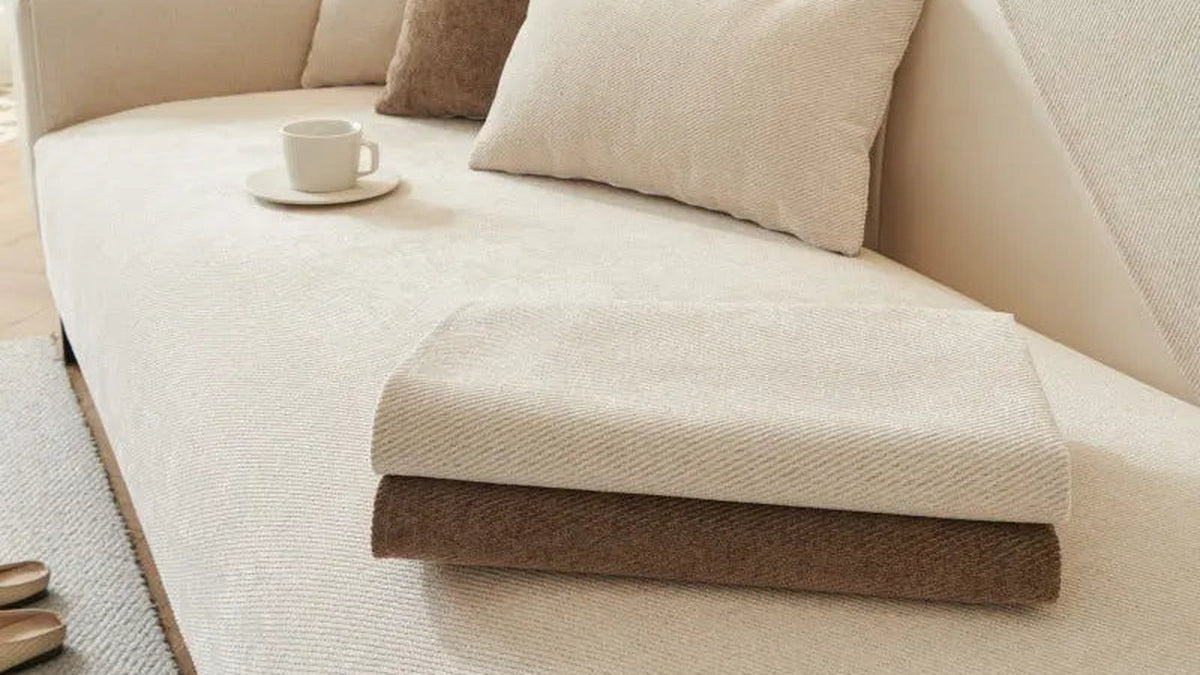
A flat cotton blend weave is the dependable choice for heavy shedders. The surface is smooth enough that hair never anchors, it breathes well so your dog is not sweating into it, and cotton blends tolerate frequent machine washing better than most synthetics. It is not the slickest fabric available, but it is the best balance of fur release, comfort and durability. This is where most shedding households should start.
Ice silk and cooling weaves: the slickest surface available
Cooling weaves, often sold as ice silk, have the smoothest hand of anything in this category. Fur sits on the surface so loosely that it sometimes slides off when you lift the cover. They are also genuinely cooler to lie on, which matters more than people realise, because heat drives shedding. A dog that is cooler and more comfortable sheds less stress-related hair in summer. The trade-off is that the slippery hand feels less cosy underfoot, and a non-slip backing becomes important.
Textured jacquard and waffle weaves: the middle ground
These have visible surface relief but no real pile depth. Hair does catch a little more than on a flat weave, but the texture also visually breaks up the stray hairs that remain, so the sofa reads as clean sooner. A reasonable compromise if you want more character than a plain weave.
Chenille, plush and faux fur: cosy, but a fur magnet
We sell these and plenty of customers love them, so let us be straight about the trade-off. Chenille and plush feel wonderful and they hide crumbs and light marks beautifully. For fur, they are the hardest option. The pile grabs hair and holds it, and once it is embedded you need a stiff rubber brush and patience. If you have a light shedder, or if your dog has a designated spot you can wash often, they are fine. If you own a double-coated dog in April, choose something flatter.
Microfiber suede and velvet: the static trap
Short, dense synthetic naps have a double problem. The nap gives hair something to grip, and the synthetic fibres build a static charge that actively pulls hair towards the fabric. Of all the options, these tend to disappoint shedding households most, because they look smooth in photos but behave like a magnet in practice.
The static problem nobody mentions
If you have ever vacuumed a cover thoroughly and watched hair reappear within minutes, you were not imagining it. Static is the hidden variable.
Synthetic fibres accumulate charge through friction, and the drier the air, the longer that charge holds. This is why fur control gets noticeably harder in winter, when heating dries indoor air. The charge pulls loose hair out of the air and off your dog and holds it against the cover, and it also makes hair resist the vacuum because it is electrostatically stuck rather than just resting there.
Three things reduce it measurably in day to day use:
- Add half a cup of white vinegar to the rinse cycle instead of fabric softener. It strips the residue that worsens cling and leaves fibres less charged. Softener does the opposite, coating fibres in a film that grabs hair.
- Raise indoor humidity. Even a modest increase makes a visible difference to how much hair stays airborne versus clinging to the sofa.
- Use wool dryer balls rather than dryer sheets if you tumble dry. They reduce static through mechanical separation instead of adding a coating.
A lightly dampened cloth wiped across the cover before you vacuum also works well. Breaking the charge first means the vacuum collects hair instead of pushing it around.
Pattern and colour: making fur invisible between cleanings
No cover stays spotless with a shedding dog. The realistic goal is to extend the window where the sofa still looks presentable, and colour choice buys you days of that for free.
The rule is simple and most people get it backwards: match the cover to your dog's coat, not to your walls. A cream dog on a cream cover is nearly invisible. The same dog on charcoal shows every strand from across the room. If you have a black Labrador, a dark cover is your friend. If you have a Golden Retriever, mid-tone beige and warm grey will serve you far better than navy.
If your dog is multi-coloured, or you have two dogs with different coats, a pattern is the way out. Leaf prints, stripes and jacquard motifs break up the visual field so individual hairs do not register as a contrasting line. Mid-tone patterns are the most forgiving surface you can buy, which is why they are worth considering even if a plain cover suits your room better.
The combination to avoid is high contrast plus flat colour: a black cover with a white dog, or a white cover with a black dog. Both look immaculate in the showroom and show everything in your living room.
Coverage format: seat pad, full drape or fitted protector
Fabric decides how easy fur is to remove. Format decides where fur ends up in the first place.
Seat pads cover the cushion area only. If your dog has one spot he always takes, this is the efficient answer. You are washing a small piece often rather than a large piece rarely, which is exactly the right trade when hair is the problem. Pick a size that covers the full seat depth plus a few centimetres of overhang so hair cannot slip into the gap at the back.
Full drape throws cover the seat, the back and often the arms. Choose this if your dog roams the whole sofa, sleeps against the backrest or climbs on the arms. The large sizes are also what you want if the sofa itself is pale and you want the cover to read as upholstery rather than a pad.
Fitted protectors wrap the seat, back and arms as one shaped piece. They stay put better than a drape and look tidier, at the cost of being specific to your sofa's width. Measure before you buy, and if you have an L-shaped sofa our sectional sizing guide walks through it.
One detail that matters more than it sounds: non-slip backing. With a shedding dog you will be lifting, shaking and re-draping the cover constantly. A cover that slides out of position every time the dog jumps on it will not get used. Grip is what makes the routine sustainable.
Our picks: sofa covers for dogs that shed
These are the covers we point shedding households towards, chosen by fur strategy rather than by price. All five are built for quick resets: shake the loose hair out first, then follow the care label on your item. Most of the range sits in our Pet Hair Resistant Throws collection.
The fur-release group
Start here if hair is your main problem. These three have the least grip, in order of slickness.

From $29.56 · 17 sizes
Flat tight-woven cotton blend - fur stays on the surface and brushes off

From $31.73 · 22 sizes
Smooth cooling weave - the least grip for fur, and cooler for heat-driven shedding

From $19.50 · 12 sizes
Textured jacquard - breaks up the look of stray hairs without a deep pile
LINÉAIRE is the one we recommend most often. The flat cotton blend weave releases hair readily, the non-slip backing keeps it where you put it, and with 17 sizes from a single cushion up to 110x240 cm you can cover a pet spot or a whole seat run. It comes in grey, coffee, beige, green and blue, so matching a coat colour is realistic.
ELYSIA is the slickest surface we stock and the one to choose for summer or for a dog that runs hot. The cooling weave gives fur almost nothing to hold, and the size range extends to matching pillow covers if you want the whole corner protected.
NUAGEA sits in the middle. The textured jacquard catches slightly more hair than a flat weave, but it disguises what remains, and at under twenty dollars to start it is the easiest way to buy two and rotate them.
When you need more than fur control
Shedding rarely arrives alone. These two handle hair while solving a second problem.

From $21.68 · 13 sizes
Soft chenille with a waterproof layer - the cozy trade-off, needs a firmer brushing routine

From $50.77 · 3 sizes
Leaf-print quilting that visually breaks up stray hair, with arm and back coverage
MIRELLE is the cosy compromise. The chenille pile will hold more hair than a flat weave, and we would rather tell you that upfront, but it adds a waterproof layer for accidents and it is the cover people actually want to sit on. Good for light to moderate shedders, or as the winter option in a two-cover rotation. For more on how waterproof layers are built and where they fail, see our sectional cover guide.
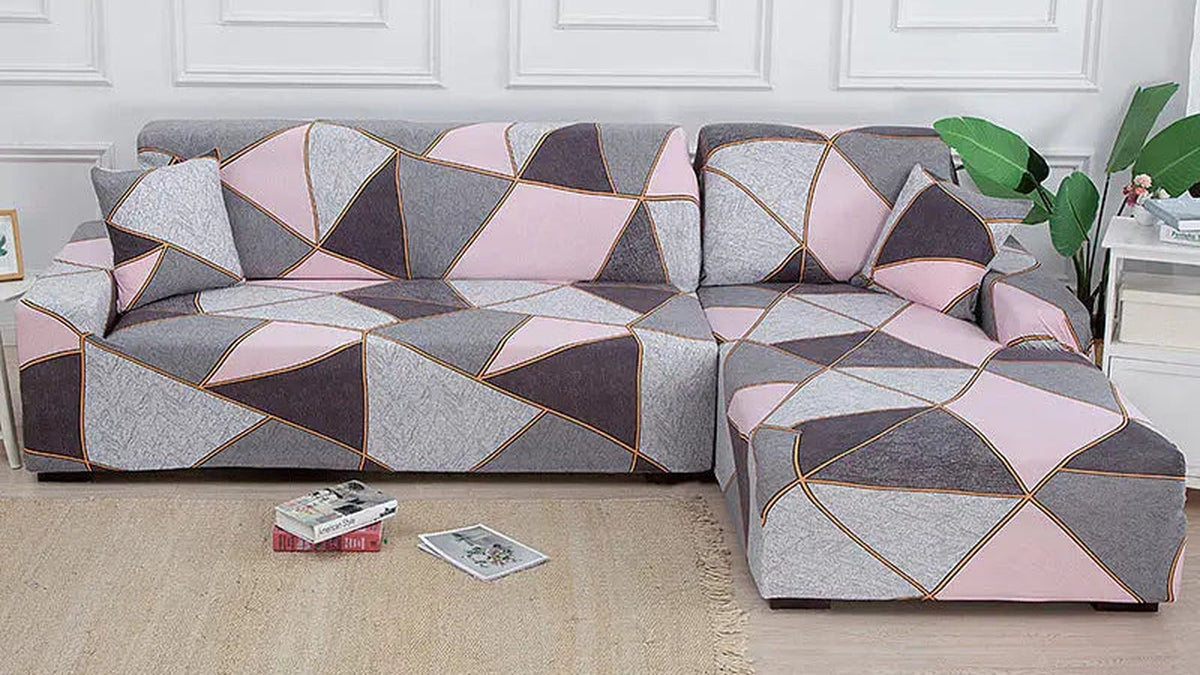
FEUILLA is the camouflage pick. The leaf-print quilting hides stray hair better than any plain fabric in the range, and because it is a shaped protector it covers the arms and back where dogs lean. Three sizes map to an armchair, a loveseat and a three-seater. Worth noting it comes in three sizes only, so measure your sofa width first.
If claws are as much of a concern as hair, our anti-scratch cover guide covers that side, and if you want to check what the waterproof treatment is made of, start with our PFAS-free explainer.
The 10-minute weekly fur routine
The right cover does most of the work. A short, consistent routine does the rest, and the order of operations matters more than the tools.
- Dry rubber brush first, always. A rubber or silicone brush creates just enough static drag to roll loose hair into a clump you can pick up by hand. Doing this before you vacuum means you remove most of the hair in about two minutes, and the vacuum only has to handle what is left.
- Vacuum against the weave. Work in one direction, then go back across it at ninety degrees. Hair lies directionally, and a single pass in one direction leaves most of it standing.
- Lint roller as a finisher only. It is the wrong tool for bulk removal and you will get through a roll in a week. Use it for the last visible strands before guests arrive.
- Shake the cover outside once a week. Thirty seconds of vigorous shaking removes a surprising amount, and it costs nothing.
The single biggest upgrade is not a tool, it is owning two covers and rotating them. One is on the sofa while the other is in the wash. It means you never postpone cleaning because the sofa would be bare, and two mid-priced covers will outlast one expensive cover used continuously.
Washing so the fur actually leaves the cover
This is where most people undo their own work. A hair-covered cover thrown straight into the machine does not come out clean, it comes out with the hair redistributed and pressed in.
- Shake and brush before the machine. Non-negotiable. Loose hair in a wash drum has nowhere to go except back onto the fabric, and into your machine's filter.
- Cold water, gentle cycle. Hot water helps hair bond to fibres and shortens the life of any waterproof layer.
- No fabric softener. It leaves a film that makes the next round of fur cling harder. Use a white vinegar rinse instead.
- Wash the cover alone. Pairing it with other laundry just spreads the hair around.
- Clean your machine's filter afterwards. A clogged filter means water recirculates through trapped hair, which is how fur ends up back on a freshly washed cover.
For drying, a tumble dry on low with wool dryer balls is actually excellent at shedding remaining hair into the lint trap. If the cover has a waterproof backing, air dry instead, because heat degrades that layer faster than anything else you will do to it.
One caveat worth stating plainly: care requirements vary by fabric and by backing, so check the care label on your own cover before you follow any of the above. The shake-and-brush step is the part that applies universally.
Shedding season: when to double up
Shedding is not constant, and planning around the peaks is easier than fighting them.
Spring and autumn are when double-coated dogs release their undercoat, and the volume during those few weeks can be several times normal. This is when a two-cover rotation stops being a nice idea and starts being the only way to keep up. Brush your dog more often during these windows too, because hair caught in a brush never reaches the sofa.
Summer brings heat-driven shedding, and a cooling cover does double duty by giving your dog a more comfortable spot and reducing the stress shedding that comes with overheating.
Winter is the static peak. Shedding volume drops but cling increases, so this is the season for the vinegar rinse and a little added humidity rather than more vacuuming.
Why choose FrenchCovers
We build covers for homes that are actually lived in. Our pet range is made for easy upkeep, many of the covers add a non-slip backing, and the size ranges run from a single cushion pad up to full three-seater coverage, so you can protect exactly the area your dog claims rather than buying more fabric than you need.
Browse the full Pet Hair Resistant Throws range, or see everything in Pet Furniture Protection if you need to handle claws and accidents alongside fur.
Frequently asked questions
What sofa cover fabric is best for a dog that sheds heavily?
A tight, flat-woven cotton blend or a smooth cooling weave such as ice silk. Both leave hair sitting on the surface where a rubber brush lifts it in one pass. Avoid high-pile chenille, plush, faux fur and microfiber suede, which let hair work down into the pile where it becomes genuinely difficult to remove.
Do pet hair resistant sofa covers really work, or is it just marketing?
The underlying effect is real, but the label is not regulated, so it is applied inconsistently. What works is physics: a smooth, low-friction surface with no pile depth cannot trap hair. Judge the fabric, not the badge. Look at the close-up photo, and if you can see raised loops or a velvety nap, it will hold fur regardless of what the listing says.
Will a sofa cover stop fur getting into my couch upholstery?
Mostly yes, with one caveat. Hair does not pass through fabric, it travels through gaps. A cover that spans the full seat depth with a little overhang, tucked into the crevice at the back, will keep fur off the upholstery underneath. A pad that stops short of the edges leaves the exact channel hair falls into.
How often should I wash a dog sofa cover?
Brush weekly and wash every one to two weeks during normal shedding, moving to weekly during a spring or autumn coat blow. Running two covers in rotation makes this painless, because the sofa is never left bare while one is in the machine.
Does a dark or light cover hide dog hair better?
Neither by default. What matters is contrast with your dog's coat. Match the cover tone to the fur and hair becomes close to invisible. Mid-tones and patterns are the most forgiving overall, and a patterned cover is the best answer if you have several dogs with different coats.
Can I put a hair-covered sofa cover straight in the washing machine?
You can, but you should not. Loose hair in the drum has nowhere to escape, so it redeposits on the wet fabric and clogs your filter, which then recirculates hair through the rinse. Shake the cover outside and brush it first. It takes two minutes and it is the difference between a clean cover and a slightly furrier one.
The short version
Stop shopping for pet covers and start shopping for surfaces. Pick the flattest, smoothest weave you can live with, match its tone to your dog's coat, buy two so one is always clean, and brush before you vacuum. That combination handles a shedding dog with about ten minutes of effort a week, which is roughly what everyone hoped the expensive waterproof cover would do on its own.