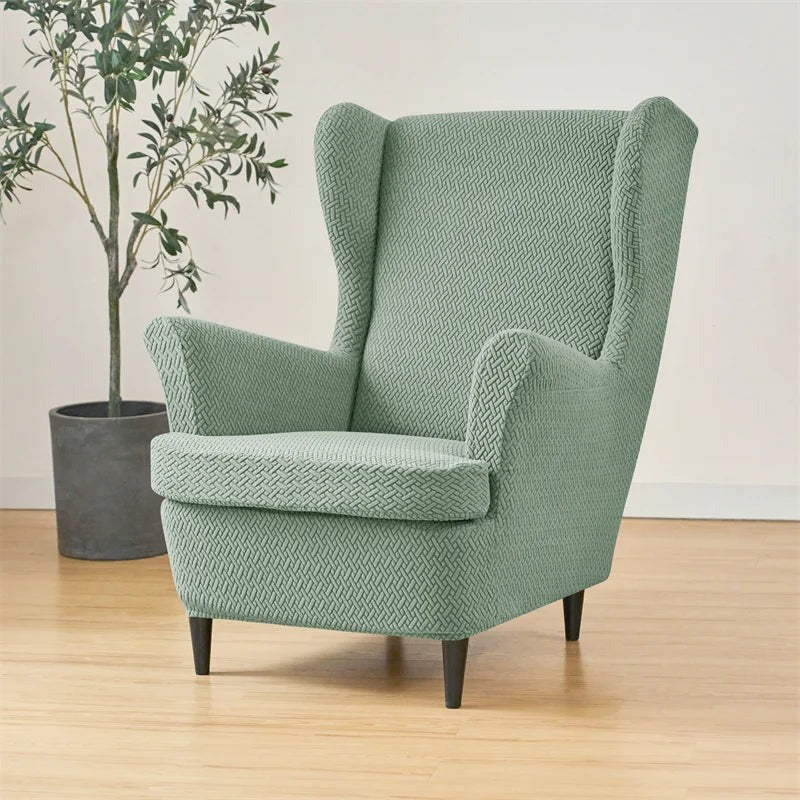
You found the perfect pattern, checked the reviews, and ordered. Then the new cover arrived, and your wingback looked like it was wearing a borrowed coat: baggy wings, a back that stopped short, a skirt bunching at the floor. If that sounds familiar, you are not alone.
Most wingback chair covers that fit badly were sized from the wrong number. People grab a tape, measure the seat from arm to arm, and compare that figure with the size chart. But wingback chair covers are not sized from the seat at all. They are sized from the top of the wings, the height of the back, and the depth of the chair from the side.
This guide walks you through that mistake, then shows you how to measure a wingback chair in about five minutes. You will see real size ranges from our own measuring guides side by side, learn three other traps that cause returns, and get fitting tips so a stretch cover stays smooth after a week of daily use. By the end, you will know exactly which numbers to write down and which cover fits your chair.

See the ARVENA jacquard cover and its size guide
The mistake: measuring a wingback chair like a sofa
When you buy a sofa cover, seat width is a reasonable starting point. A three-seater is mostly seat, and the arms add a predictable amount on each side. A wingback chair works differently. Its widest point is usually at the top, where the two wings flare out beside your head. The seat sits lower and narrower, tucked between the arms.
Look at the measuring guide for our ARVENA wingback chair cover above. The seat width it lists is 23.6-27.6 inches (60-70 cm). The width across the top of the wings is 30.7-33.5 inches (78-85 cm). That gap is several inches on any chair in this range. If you measure only the seat and match it to the wrong line of a size chart, you can easily land on a cover meant for a much smaller or much larger frame.
Height causes the second half of the problem. A wingback has a tall back by design, because the wings were originally meant to block drafts around the sitter's head. You can read more about the wing chair's history if you are curious about where the shape comes from. For sizing, the takeaway is simple: the back height decides whether the cover reaches the floor or stops halfway down the legs.
So the fix is not a better tape measure. It is measuring the parts of the chair that the cover actually wraps, in the order a size chart lists them.
How to measure a wingback chair in 5 minutes
Grab a flexible measuring tape, a notepad, and your phone camera. Remove any throw or loose pillow from the chair first. Write every number in both inches and centimeters, since many measuring guides print both, and rounding errors add up fast on a narrow size range.
Width across the top of the wings
Stand behind the chair. Run the tape straight across the top of the back, from the outer edge of one wing to the outer edge of the other. Keep the tape level, not curved over the top. This is the width across the wings, and it is the first number most wingback size charts show. If your wings flare outward, measure at the widest point near the top, not where they meet the arms.
Back height, floor to top
Measure from the floor to the highest point of the back, keeping the tape vertical along the back of the chair. Include the legs. A cover's height range assumes the fabric runs from the top of the back down to the bottom of the frame, so a chair with tall legs and a short back can measure the same total as a chair with short legs and a tall back. That is fine: the stretch fabric handles the difference, as long as the total sits inside the range.
Side depth, front of the arm to the back
Move to the side of the chair. Measure at the base, from the front of the arm (or the front leg) to the back of the chair. Most guides draw this line along the bottom edge of the side panel. Seat depth is not the same thing: it stops at the backrest and misses the thickness of the back frame. Measure the full side depth, because that is the distance the cover has to travel.
Seat cushion and footstool
Lift the seat cushion. If it comes out, your chair has a separate cushion, and you need a cover set that includes a seat cushion cover. Note its thickness. If the seat is fixed, a one-piece cover will do.
Finally, if you own a matching ottoman or footstool, measure its length, width, and height now so you can order everything in one go. Take one photo from the front and one from the side, then compare them with the product photos before you order.
Wingback chair cover size ranges compared
Here is how the published measuring guides for our wingback chair covers compare. These are the ranges printed on each product's sizing image, so they are the numbers to check your chair against. Ranges are copied exactly as printed, so a few inch and centimeter conversions do not match perfectly; when they disagree, go by the centimeters. Fields marked "not listed" are not shown on that guide.
| Cover | Width across the wings | Back height | Side depth | Seat width |
|---|---|---|---|---|
| ARVENA (jacquard, flat arms) | 30.7-33.5 in (78-85 cm) | 37.4-39.4 in (95-100 cm) | 33.1-35.4 in (84-90 cm) | 23.6-27.6 in (60-70 cm) |
| LIRAVO (velvet, flat arms) | 30.7-33.5 in (78-85 cm) | 37.4-39.8 in (95-100 cm) | 33.1-35.4 in (84-90 cm) | not listed |
| VALENI (floral, roll arms) | 27.5-31.3 in (69-80 cm) | 37.4-43.3 in (95-110 cm) | 31.5-36.2 in (80-92 cm) | not listed |
| VALERIN (floral spandex, roll arms) | 28-39.4 in (70-100 cm) | 31.5-43.3 in (80-110 cm) | 28-33.5 in (70-85 cm) | not listed |
| ARVENA stool cover | 21.6-25.6 in long (55-65 cm) | 7.9-11.8 in high (20-30 cm) | 13.7-17.7 in wide (35-45 cm) | - |
Three patterns stand out. First, the flat-arm models have a narrow height window of about two inches, so a tall chair will not fit them even if its width is perfect. Second, the roll-arm guides accept a much taller back, up to 43.3 inches, but start at a narrower width across the wings. Third, the VALERIN stretch wing chair cover has the widest spread on every measurement, which makes it the forgiving choice for a chair that sits between ranges.
How to read the table: your chair should land inside the range on all three main lines (wings, height, depth), not just one. If two numbers fit and one is out by an inch, the stretch fabric may absorb it on the width, but rarely on the height. When in doubt, favor the model whose height range covers your chair comfortably.
Three more wing chair cover size traps
Getting the measurements right solves most problems. These three slip through even when the numbers are correct, and each one is a common reason a cover ends up back in the box.
Ordering the footstool variant by accident
Many wingback listings sell the chair cover and the footstool cover on the same page, as separate options. The codes usually tell them apart: options marked "Wingchair Cover" are the chair, options marked "Footstool Cover" or "Stool Cover" are the ottoman. Because a footstool cover costs less (from $19.87 versus $44.87 to $54.87 for a chair cover on our listings), the cheaper price can catch your eye in the dropdown.
Before checking out, read the full option name in your cart. If you want both, add two lines, one per piece. If you prefer a single order, the TIGRÉA flannel set with a footrest cover comes as a 3-piece set (chair, cushion, and footrest) in one option.
Ignoring the arm style
Wingbacks come in two broad families. Classic wingbacks have rolled arms that curve outward, a loose seat cushion, and often turned or curved legs. Modern wingbacks have flatter, flared arms, slimmer wings, and straight tapered legs; some listings call this shape a "tiger chair". A cover cut for one family will pull or sag on the other, even when the tape says the size matches.
Compare your chair's arms with the line drawing on the size guide. The VALENI floral wingback chair slipcover is drawn for the rolled-arm shape, while ARVENA and LIRAVO follow the flat-arm modern silhouette.
Forgetting the separate seat cushion
If your seat cushion lifts out, a one-piece cover will either flatten it or leave it exposed. Look for a set that includes a seat cushion cover. On our classic-style models, the cushion cover comes with the chair cover, so the seat gets its own snug layer instead of being stretched over by the main piece. If your seat is fixed to the frame, skip the set and pick a one-piece cover: fewer seams means a cleaner look.
Fitting a stretch wingback chair cover so it stays put
Even a perfectly sized stretch cover needs a good install. Plan ten minutes the first time; after that, it takes about three.
- Start at the top. Pull the cover over the back and settle the wing pockets on the wings first. The wings anchor everything else.
- Work the arms next. Ease the fabric down over each arm, smoothing toward the front. On rolled arms, make sure the seam sits on the outer curve.
- Tuck the seat crevice. Push the extra fabric deep into the gap between the seat and the back and arms. A rolled magazine or a wooden spoon handle helps. This tuck is what keeps the cover from creeping forward.
- Finish underneath. Pull the elastic hem under the frame and secure any ties around the legs.
- Add the cushion cover last. Slide it on like a pillowcase, zip or tuck, and put the cushion back in place.
For care, follow the label on your cover. Our listings call for gentle washing and no bleach, and the VALENI listing is machine washable on a gentle cold cycle. Put the cover back on while it is still slightly damp: the stretch fabric relaxes into the chair's shape as it dries, giving a smoother fit. If you are weighing stretch against tailored options for other seats in the room, our comparison of stretch and fitted covers explains how each one behaves over time.
One more tip: if the cover keeps loosening at the front edge, the tuck is too shallow. Push more fabric into the crevice rather than tightening the hem, which only pulls the wings out of place.
Why choose French Covers for your wingback chair slipcover?
We publish real measuring guides on our wingback listings, so you can check your chair against actual ranges instead of a vague "one size fits most". Our range covers both families of wingback, from rolled-arm classics to flat-arm modern frames, in jacquard, velvet, floral prints, and plush fabrics. Many chair options include a matching seat cushion cover, and matching footstool covers are sold on the same page so the whole set looks coordinated. Every cover slips off for washing, which matters when kids and pets share the chair. Here are four we recommend depending on your chair.

LIRAVO - soft velvet for flat-arm wingbacks

VALENI - floral print for rolled arms

VALERIN - widest size range

VIVANE - cozy plush texture
- Wingback Chair Cover Velvet Stretch LIRAVO - a velvet and spandex blend with a matching cushion cover, plus an optional footstool cover.
- Wingback Slipcover Plush Stretch VIVANE - a warm plush finish that turns a reading corner into the coziest seat in the house.
Not sure your chair is a true wingback? If it has a rounded back and no wings, browse our club and barrel chair covers instead, where the sizing logic is different.
Frequently Asked Questions
Are wingback chair covers one size fits all?
No. Even a one-size fit stretch cover works within a size range, not with unlimited flexibility. A cover drawn for a flat-arm modern wingback with a 37.4-39.4 inch back will not fit a classic chair with a 42-inch back, however much it stretches. Check the width across the wings, the back height, and the side depth against the measuring guide on the product page before ordering.
What if my wingback chair is between two size ranges?
Prioritize height, because stretch fabric absorbs extra width far better than extra height. If your chair is just over a range on width but well inside on height and depth, the cover will usually work. If it is outside on height, choose a model with a taller range, such as one of the rolled-arm guides that go up to 43.3 inches.
Do wingback chair slipcovers fit chairs with a separate seat cushion?
Yes, if you pick a set that includes a seat cushion cover. The main piece wraps the frame, and the cushion gets its own snug cover. Without it, the main cover either flattens the cushion or leaves it bare. Lift your cushion before ordering to check whether it comes out.
Can I cover a matching ottoman or footstool too?
Yes. Several of our wingback listings offer a footstool cover as a separate option on the same page, so the pattern matches. Measure the footstool's length, width, and height, and compare them with the stool guide; for ARVENA, that is 21.6-25.6 inches long, 13.7-17.7 inches wide, and 7.9-11.8 inches high. Add the stool and the chair as two separate lines in your cart.
How do I keep a stretch wingback cover from slipping?
Tuck deeply. Push the spare fabric into the crevices between the seat, the back, and the arms, using a rolled magazine or a spoon handle to get it all the way in. Then pull the elastic hem fully under the frame. If the front still creeps, tuck more rather than tightening the hem.
Can I put a wingback chair cover in the washing machine?
Yes, in most cases: our wingback covers slip off easily for washing. Follow the care label on your cover: use a gentle cycle, avoid bleach, and choose cold water where the label calls for it. Refit the cover while it is slightly damp for the smoothest finish.
The sizing mistake almost everyone makes is treating a wingback like a small sofa and measuring the seat. Measure the width across the wings, the back height from the floor, and the side depth, check whether your arms are rolled or flat, and note any separate cushion or footstool. With those five details, choosing wingback chair covers becomes a quick check against a guide instead of a guessing game. Your chair keeps its shape, your fabric stays smooth, and you skip the return.
When you have your numbers, start with the ARVENA jacquard wingback chair cover and compare it with your notes.
Want more patterns and fabrics? Browse our full range of wingback chair covers to match your chair's shape and style.